FREE GUIDE · NO EMAIL NEEDED · THE FULL PLAYBOOK

One command.
A full client launch.
/goal

The exact prompt, how the loop works under the hood, and five copy-paste starter skills so you can run the same play in your own agency. Everything on this page is free and ungated.

24 deliverables 1 prompt ~$10 API spend 0 emails required to read this
youtube — the /goal run watch on youtube ↗

The full run, start to finish. Everything below is the written version.

01 · WHAT ACTUALLY HAPPENED

One afternoon, one prospect, the whole pitch

The client in the video is a UK property management company, a real prospect we wanted to close. Instead of a deck and a promise, we typed one /goal command into Claude Code and let it build the entire pitch package. It asked four scoping questions, then worked through the list until everything existed, was checked, and was live.

2landing pages designed, built and deployed to live preview URLs
11strategy + copy documents, formatted, in the client's folder
8ad statics, vision-graded against the brand before delivery
3AI video ads with voiceover, rendered and verified

Rebranded homepage concept, live on a preview URL

Long-form direct-response landing page

Brand book: palette, type, voice, photo rules

Acquisition strategy with budget projections

4 Meta ad angles, long + short primary texts

6-email nurture sequence in the owner's voice

SMS, WhatsApp and call scripts for speed-to-lead

2 branded PDF documents in the new brand system

02 · HOW /GOAL WORKS

A goal it isn't allowed to abandon

/goal sets a finish line, not a to-do item. The command registers a condition, and the session cannot end until that condition is true. That single mechanic changes the behaviour completely: instead of doing one step and reporting back, the model plans the whole job, works it, checks its own output, and keeps going.
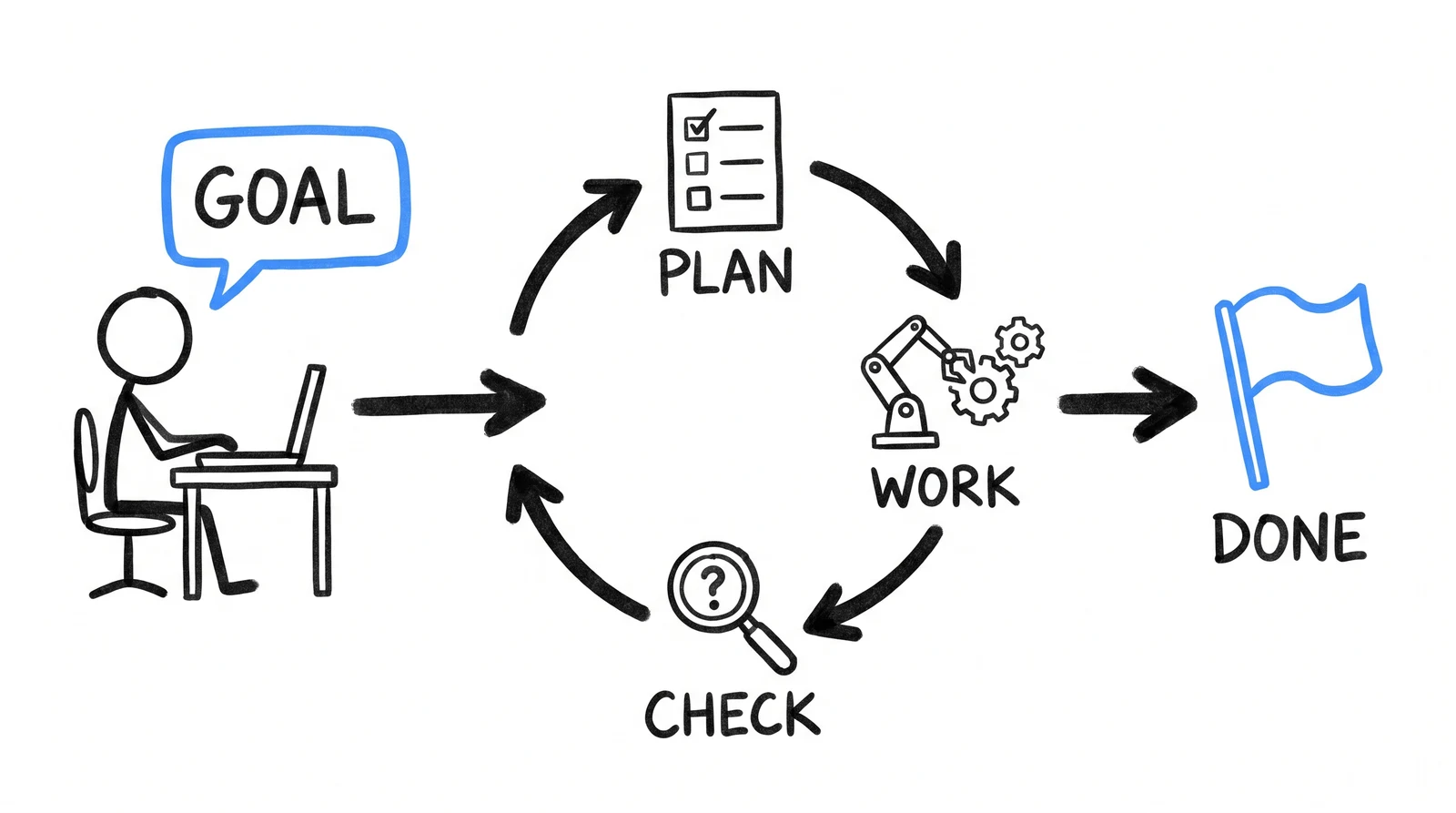
Doodle: a goal enters a plan-work-check loop until done

The loop: every deliverable goes through plan → work → check before the flag drops.

  1. It asks before it builds. A good goal ends with "ask questions if needed". Ours came back with four sharp multiple-choice questions (deal status, brand direction, audience, video style) before touching anything. Thirty seconds of answers replaced hours of wrong guesses.
  2. It plans in deliverables, not steps. The goal becomes a checklist. Each item has an acceptance test: a page isn't done until it's deployed and screenshot-verified, an ad isn't done until a second pass grades it 8/10 or better.
  3. It delegates. Copywriting went to a copywriter agent with its own self-test loop. Design judgment went to a designer agent. They ran in parallel while the main session kept building.
  4. It verifies, then stops. The videos were checked frame-by-frame, the pages were screenshot on desktop and mobile, one weak ad was caught and re-rendered. Only then did the goal clear.
03 · THE STACK BEHIND IT

Skills, agents, tools

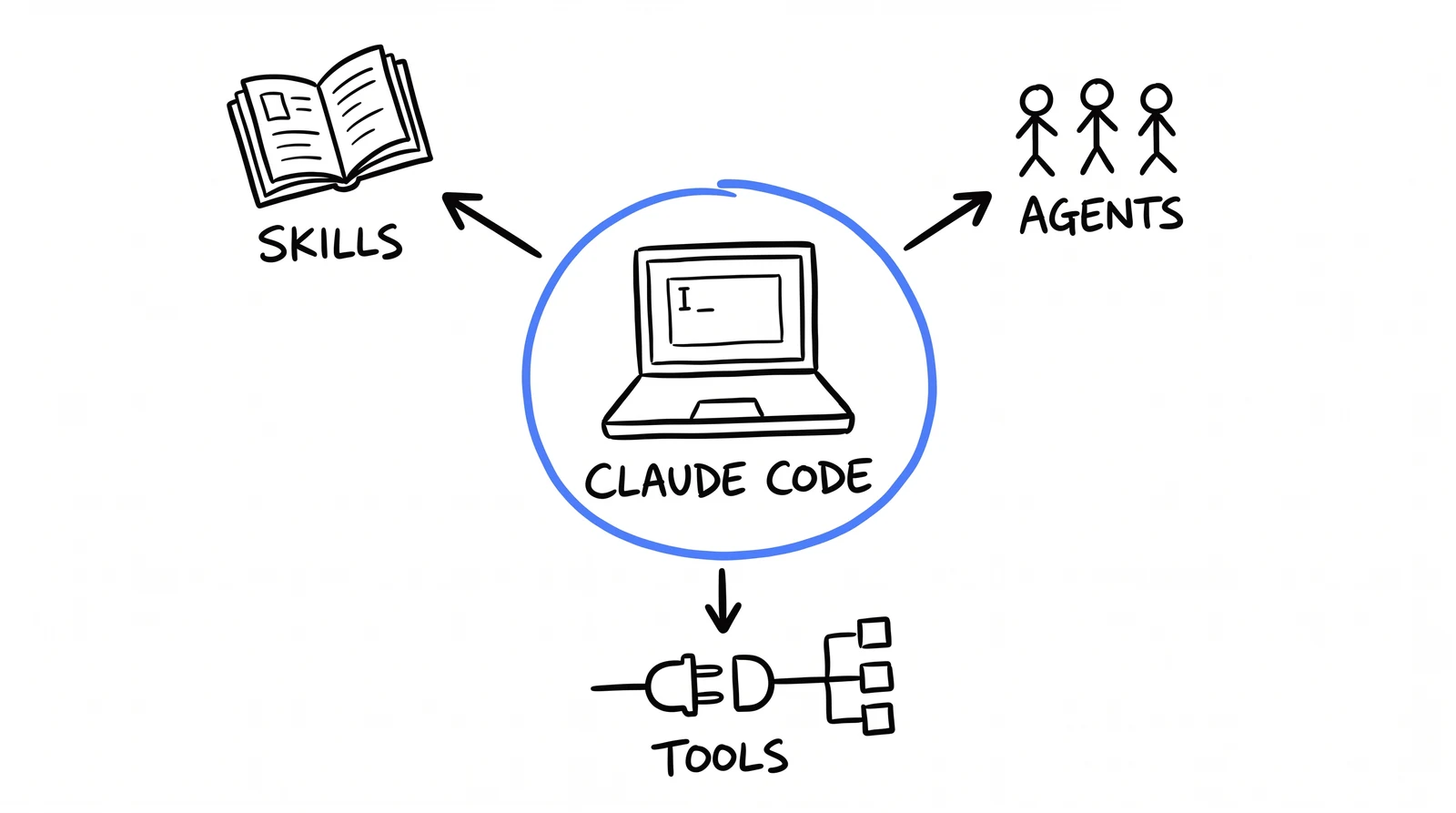
Doodle: Claude Code at the center, connected to skills, agents and tools

Claude Code is the operator. Skills are its playbooks, agents are its team, tools are its hands.

Skills are written procedures, markdown files that teach the model exactly how your agency does a thing: how you write ads, how you build landers, what "done" means. Agents are specialists with their own context window and their own standards, so the copywriter judges copy without being distracted by everything else. Tools are the APIs underneath: image generation, video rendering, document creation, deployment.

Nothing in the stack is exotic. What makes it compound is that every procedure is written down once and then executed the same way every time, by something that never forgets to run the checklist.

Nano Banana (via Krea API) ~$0.08/image

Image generation for scenes and doodles. Ad copy is never drawn by the model — real text is composited in HTML so nothing is ever misspelled.

HeyGen ~$2/video

Avatar-less "scenes" video ads: b-roll, boxed kinetic captions and voiceover from a structured script. 30 seconds, brand colors, no editor.

Google Docs + Drive API free

Every document lands formatted in the client's folder with a shareable link. No copy-pasting out of a chat window.

Cloudflare Pages + Playwright free

Landing pages deploy to live preview URLs in seconds; Playwright screenshots them on desktop + mobile so the model can see and fix its own work.

04 · THE EXACT PROMPT

Steal the goal

This is the real prompt from the video, with the client's domain swapped out. Notice what it is: a subject, a source of truth, a bullet list of deliverables, and an escape valve. No essay, no context dump.

claude — /goal
/goal clientwebsite.com I want you to create:
- a full rebranding landing page
- a high-performance landing page
- brand doc
- strategy doc
- Facebook ads
- single images
- video ads
- copy for everything
- automated sequences, the full thing for this client

Ask questions if needed
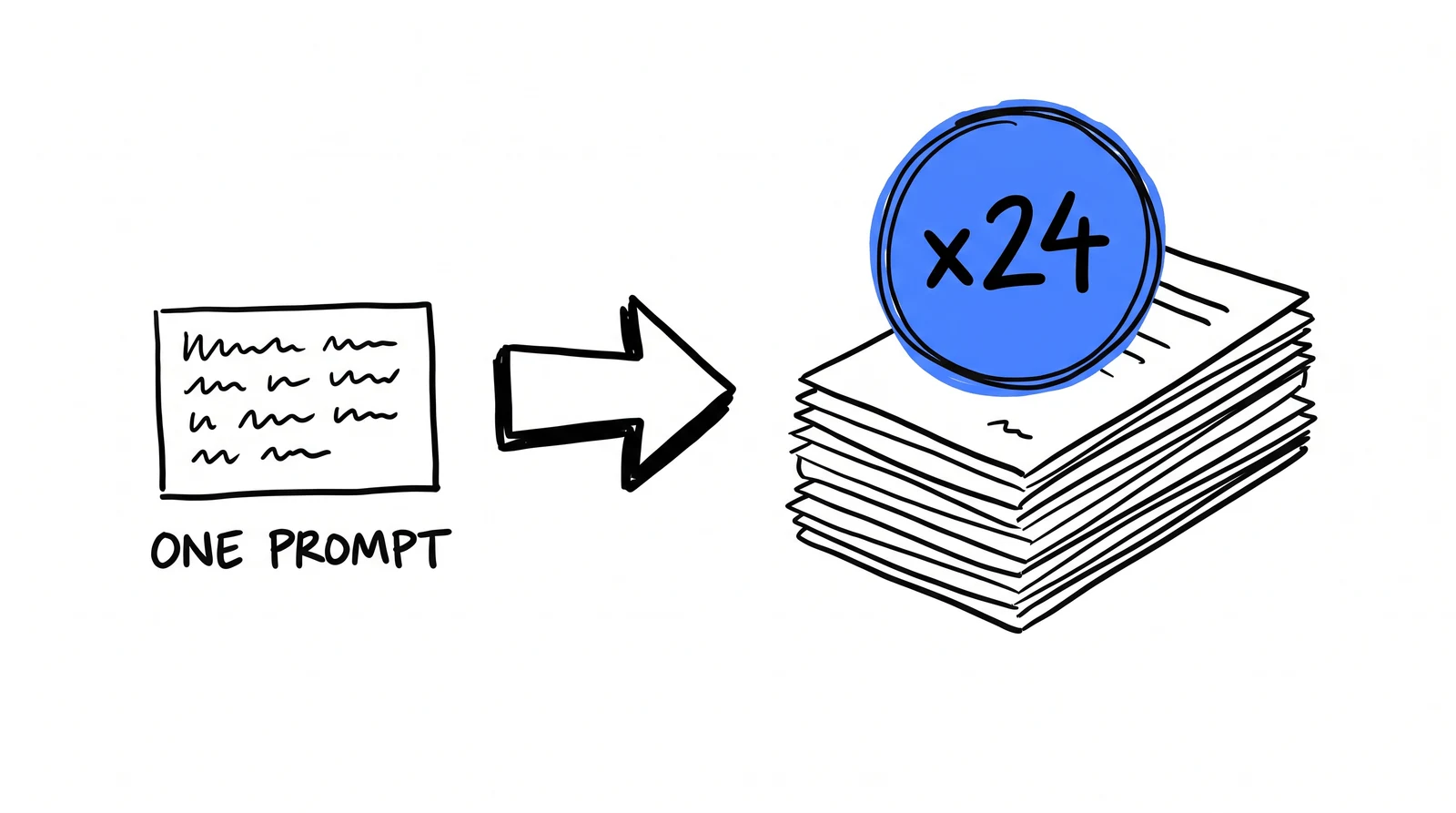
Doodle: one prompt becomes 24 deliverables

clientwebsite.com — the source of truth

The model scrapes the real site first and builds a verified fact table. Real occupancy numbers, real founders, real phone number. House rule: never invent proof.

Bullets — deliverables, not vibes

Each bullet becomes a checklist item with its own acceptance test. "Copy for everything" fans out into ads, emails, SMS and page copy automatically.

Ask questions if needed — the escape valve

Cheapest insurance in the prompt. Four multiple-choice questions up front beat four wrong deliverables at the end.

What we'd add for you

Constraints, when they matter: language, budget ceiling, "preview only, launch nothing", deadlines. One line each, at the end.

05 · TAKE THE SKILLS

Five starter skills, copy-paste ready

These are simplified, self-contained versions of the skills from the video, rewritten so they work in any Claude Code setup with zero dependencies. Install: create the file .claude/skills/<name>/SKILL.md in your project and paste the block in. Or just paste the whole block into a chat as a prompt — it works both ways.

1. goal-loop

.claude/skills/goal-loop/SKILL.md

The orchestration pattern itself. Turns any deliverable list into a plan-work-check loop that doesn't stop early.

SKILL.md
---
name: goal-loop
description: Run a multi-deliverable goal to completion. Use when the user
  gives a list of things to produce for a client or project.
---

When the user gives you a goal with multiple deliverables:

1. SCOPE FIRST. Before building anything, ask up to 4 sharp
   multiple-choice questions covering the decisions that change the
   work (audience, brand direction, format, constraints). Never ask
   open-ended questions you could answer yourself from their website.

2. PLAN IN DELIVERABLES. Restate the goal as a checklist. Every item
   gets a one-line acceptance test, e.g.:
   - landing page → "deployed to a preview URL and screenshot-verified
     on desktop AND mobile"
   - ad creative → "second review pass scores it 8/10 or better
     against the brand doc"
   - document → "formatted, in the client folder, link surfaced"
   Keep the checklist visible and updated as you work.

3. BUILD THE SOURCE OF TRUTH FIRST. Scrape the client's real website.
   Write a brand/facts file with every verifiable number, name and
   claim. Rule: no deliverable may contain a number that is not in
   this file. Never invent testimonials, stats or credentials.

4. WORK THE LIST. One item at a time or in parallel where independent.
   After each item, run its acceptance test yourself. If it fails,
   fix and re-test before moving on. Maximum 2 fix passes, then flag
   the gap loudly instead of shipping quietly broken work.

5. ONLY STOP WHEN THE LIST IS DONE. The final message is a clean
   summary: every deliverable, every link, anything flagged. No
   "next steps I could do" padding. If a deliverable was impossible,
   say exactly why and what is needed.

2. brand-dna-builder

.claude/skills/brand-dna-builder/SKILL.md

Builds the verified fact table + brand direction every other skill depends on. This is what stops AI from inventing proof.

SKILL.md
---
name: brand-dna-builder
description: Build a brand DNA file from a client's real website. Use
  before any creative or strategy work for a new client.
---

Input: the client's website URL (plus any subpages the user names).

1. FETCH the homepage and the 2-3 most important subpages (about,
   services, pricing). Read what is actually there, not what you
   assume.

2. WRITE brand-dna.md with these sections:

   ## Verified proof stack
   A table of every claim you can quote from their site: years in
   business, client counts, results, accreditations, guarantees,
   founder names, phone, email, hours. Mark the source page of each.
   RULE FOR ALL FUTURE WORK: only these numbers may appear in copy.
   If it is not in this table, it does not exist.

   ## Current brand state
   What their site looks and sounds like today: colors (grab real hex
   values), fonts, tone, weaknesses. Be honest.

   ## Direction
   Positioning line (one sentence a customer would repeat), palette
   (5-6 named colors with hex + usage), typography (display + body),
   photography rules (real photos only? what mood?).

   ## Voice
   5 rules with examples. Include a banned-words list (start with:
   unlock, elevate, seamless, hassle-free, game-changer, journey)
   and one sentence the brand would NEVER say.

   ## The one-sentence test
   Describe the exact customer, then: "If [that person] reads the
   page and thinks [desired reaction], it works."

3. Keep it under 2 pages. A brand doc nobody reads protects nobody.

3. dr-copywriter

.claude/skills/dr-copywriter/SKILL.md

Direct-response copy with a built-in self-test loop that catches AI-tells before you ever see them.

SKILL.md
---
name: dr-copywriter
description: Write direct-response copy (ads, landing pages, emails)
  that survives an AI-tell audit. Requires a brand-dna.md.
---

Before writing: read brand-dna.md. Every number you use must come
from its verified proof stack. No exceptions, no rounding up.

WRITING RULES
- Every promise carries a number. "Faster" is not a claim;
  "answered within the hour" is.
- Short sentences. One idea each.
- No em-dashes anywhere.
- Banned words: unlock, elevate, seamless, hassle-free, game-changer,
  revolutionize, "imagine a world", "in today's fast-paced".
- One CTA per piece. Low-commitment beats high-commitment for cold
  traffic (an estimate or a checklist beats "book a call").
- Headlines: write 2-3 options (A/B/C), body copy single version.

SELF-TEST LOOP (mandatory, before delivering)
Score your draft 1-10 on each, rewrite until every score is 9+:
1. Read-aloud test: would the business owner actually SAY this
   sentence to a customer, on the phone, without cringing?
2. Specificity: does every claim carry a verifiable number or name?
3. AI-tell scan: any banned words, em-dashes, three-adjective
   stacks ("fast, reliable, and professional"), or "it's not X,
   it's Y" constructions? Kill them.
4. One-big-idea: can you state the piece's single idea in one
   sentence? If it has two ideas, split it.
5. The customer test from brand-dna.md.

Report the final scores with the delivery. If any dimension is
below 9 after 3 rewrites, deliver anyway and flag which test failed
and why. Never silently ship a failing draft.

4. ad-statics-designer

.claude/skills/ad-statics-designer/SKILL.md

The trick from the video: the model never draws your text. Ads are built as HTML and screenshot at print quality, so copy is pixel-perfect every time.

SKILL.md
---
name: ad-statics-designer
description: Produce Meta ad statics as HTML/CSS rendered to PNG.
  Real text, real brand fonts, real photos. Requires brand-dna.md
  and Playwright (npm i playwright).
---

CORE RULE: image models misspell and hallucinate text. So the ad is
an HTML page: brand fonts loaded from Google Fonts, real copy as
real text, the client's actual photo as the background. Then
screenshot it. Nothing is ever "drawn".

For each ad concept:
1. Write the on-image copy first (use dr-copywriter rules).
   Max 20 words on the image. One loud message. One solid CTA button.
2. Build a single HTML file: a fixed-size div (1080x1350 for 4:5,
   1080x1080 for 1:1), brand colors from brand-dna.md, the photo as
   a full-bleed img with a gradient scrim where text sits, logo
   visible (top corner chip), headline at 72px+ equivalent.
3. Screenshot with Playwright:
   const { chromium } = require('playwright');
   const b = await chromium.launch();
   const p = await b.newPage({ viewport: {width:1080, height:1350},
     deviceScaleFactor: 2 });
   await p.setContent(html, { waitUntil: 'networkidle' });
   await p.screenshot({ path: 'ad-01.png' });
4. LOOK at the rendered PNG (read it back). Check: text legible on
   the photo? headline big enough at thumbnail size? logo crisp?
   copy verbatim? Fix and re-render until it passes.

BATCH RULE: a set of 4 ads should MIX patterns — one photo hero,
one pure-typography statement on a flat background, one offer card
with 3 checkmarks, one big-number comparison. Four lookalike heroes
is one ad tested four times.

5. video-ad-scriptwriter

.claude/skills/video-ad-scriptwriter/SKILL.md

Writes the structured script an AI video tool (HeyGen and similar) can execute: timed scenes, boxed captions, and a voiceover that fits the runtime.

SKILL.md
---
name: video-ad-scriptwriter
description: Write 25-35s avatar-less video ad scripts (b-roll +
  kinetic text + voiceover) for AI video tools. Requires brand-dna.md.
---

THE MATH THAT MAKES OR BREAKS IT
Voiceover word budget = duration x 2.3 words/second.
30s video = 69 words MAX. Count them. Over budget = the ending gets
cut off or rushed. Under budget is fine (b-roll fills the space).

For each script, produce:

1. VO (55-75 words for 30s). Conversational, hook inside the first
   2 seconds, ends with a low-commitment CTA ("free estimate in 60
   seconds" beats "contact us today"). Every number from the
   verified proof stack.

2. SCENES: 6 timed directions, each ending with a boxed text
   overlay of 3-6 words. Format:
   [0-3s] HOOK: .
     Boxed overlay (top): ""
   [3-8s] ... overlay: ""
   ...
   [25-29s] solid brand-color end card. Centered boxed overlay:
     ""

3. RULES baked in:
   - describe visuals concretely ("close-up of a phone banking app
     as a payment lands"), never abstractly ("success imagery")
   - specify the casting and setting to match the market, or the
     tool defaults to generic global stock
   - brand colors stated explicitly (background + accent hex)
   - one idea per scene; the overlays alone must tell the story
     with the sound off

Write 3 script variants per campaign: 3 different hooks (the
promise, the number, the pain), same offer and CTA.
ia_ — updates

$ subscribe --to "the next drop"
# New guides, new skills, new teardowns like this one, when they ship.
# No spam. No gate. This page stays free either way.

✓ subscribed. next drop lands in your inbox.

unsubscribe = one reply. we read those.

DONE-FOR-YOU

Want this installed in your agency?

Everything on this page is the self-serve version. The Install is the done-for-you one: your skills, your agents, your clients, built into your agency in 30 days by an operator who runs one.